

Growing up in Hong Kong, Wesa Chau Wai-sum never thought she would enter the world of politics. But a move to Australia when she was seven changed all that. Now 31, Chau is hoping to become Australia's first Asian-born member of the House of Representatives, running as a candidate for Prime Minister Kevin Rudd's ruling Labor Party in the September 7 federal election.
ACYD Alumni…where are they now? Amy King

1. What have you been working on since participating in the Dialogue in 2010?
After participating in the Dialogue in Beijing and Shanghai in 2010, I went straight back to Beijing to complete another round of archival research in the Chinese Foreign Ministry. This archival research formed part of the research for my PhD on China's foreign economic policy towards Japan during the first two decades of the Cold War. Drawing on hundreds of recently declassified Chinese archival records, my PhD argued that despite China’s experience of Japanese imperialism, industrialisation and war during the first half of the twentieth century, China's Communist leaders viewed Japan as an important source of industrial goods, technology and expertise, and a symbol of a modern, industrialised nation-state. This meant that after 1949--and despite the fact that they were situated on opposite sides of the Cold War divide, China's leaders tried hard to rebuild an economic relationship with Japan. My research challenges a couple of common narratives that we often hear about the China-Japan relationship: either that China-Japan relations were nonexistent before diplomatic recognition in 1972, or that they have been purely conflict-ridden since the end of the Second World War. After completing my PhD at Oxford University in 2012, I moved back to Australia in 2013 to take up a Lectureship with the Strategic and Defence Studies Centre at the Australian National University. At the ANU I teach on international security in the Asia-Pacific, and on Chinese defence and security policy.
2. How has the Dialogue helped you get to where you are?
The Dialogue was a fantastic way to meet a whole range of Australians and Chinese working on cutting edge issues facing China today. During the 2010 Dialogue, I was thrilled to have the opportunity to hear from people like Richard Rigby, Jeremy Goldkorn, Geremie Barme, Philippa Jones, and Jingdong Yuan, who are leading experts on China's foreign policy, media, history, environment and security. Speaking with these experts, and discussing with fellow delegates the issues raised at the Dialogue, has strongly shaped my thinking about China.
3. How do you influence the Australia China relationship on a day to day basis?
Although my own work does not focus specifically on the Australia-China relationship, there are a number of ways in which I think my research and teaching is having some small influence on this relationship. In my research, I try to enhance our understanding of China, and how China's history--particularly its history of conflict and economic interdependence with Japan--play a role in shaping it's foreign policy and security outlook today. I think we in Australia still have a fairly limited understanding of China's past and present foreign and security policy, partly as a result of the difficulty of studying China and getting access to its archives, official documents, and policy-making community. Though there are challenges to studying China, it is by no means impossible, and I hope that in the coming years I can contribute to the impressive community of China scholars at the ANU who are all trying to increase our understanding of China. Outside of my own research, every year I teach a hundred or so undergraduates and postgraduates at the ANU about China. Many of these students will go on to play a role in Australia's business, foreign policy, defence and aid relationship with China, and so I hope that through the debates and discussions we have about China in my lectures and seminars, I am contributing to Australia's future China-watching community.
Amy King will be a facilitator for the crisis simulation session at the 2013 Australia-China Youth Dialogue
Deputy Director of the ACYD Natalie Cope will speak at the Australian Education Foundation National Conference

Natalie Cope, Deputy Director of the Australia–China Youth Dialogue and Manager of Partnerships and Development at Asialink will speak on a panel next Wednesday as part of the Australian Education Foundation National Conference. Speaking alongside four fellow eminent young professionals, she will consider 'So what does it mean to be a global citizen in the Asian century?'. Members of the public are invited to submit questions via the link below, as well as listen to the session live on Wednesday the 14th at 2:30pm AEST. Please see http://www.asiaeducation.edu.au/conference_q_and_a_panel.html for more details.
Interview with ACYD Alumni and Fairfax's China Correspondent Phil Wen

Ahead of ACYD Alumni Phil Wen’s move to China to take up the prestigious role of China Correspondent for The Age and the Sydney Morning Herald, ACYD Executive Director Fiona Lawrie sat down with him to discuss the challenges and opportunities ahead for the Australia China relationship.
Fiona Lawrie – Firstly, congratulations on being appointed The Age and The Sydney Morning Herald’s correspondent for China. This is an extremely prestigious role and you have big shoes to fill [John Garnaut, previous Fairfax correspondent in Beijing]. What are the biggest challenges you are expecting to face going into this enormous role?
Phil Wen – I am really fortunate that John Garnaut has been an extremely well respected journalist in China. Because of his strong reputation for the thorough and fair reporting that he has brought to Beijing, people will be more open to talking to me, confident that their stories will be properly represented. John Garnaut has really set the bar high.
FL – What are you most looking forward to about taking up this role?
PW – My strength is in telling the stories of ordinary Chinese people. I am looking forward to bridging the cultural divide, bringing understanding to big topics that are often ignored to give way for the important economic stories. I believe that there is a consensus that China’s economy is slowing, and as that is becoming more and more apparent, there is a momentum towards accepting China’s current growth isn’t sustainable and looking at other issues fundamental to the country. I look forward to covering in detail the new government leading the country, as well as the environment.
FL – You have got one of the most sought after jobs in journalism; however, you haven’t always been a journalist. Tell me about your journey to get to where you are.
PW – I have always read the newspaper, but as a kid I used to start from the sport and the ‘Green Guide’ section. I did a Bachelor of Commerce at university and got a graduate position with KPMG in their tax division. I enjoyed it at the beginning, but as time went on, I realised that I was going to do the role for the next 30 – 40 years so I better enjoy it. The turning point was during the Global Financial Crisis when I realised that I wanted to be made redundant so that I could get a package, but it didn’t happen. Showing up to work hoping to get sacked is not the key to a successful career.
I studied journalism at the University of Technology Sydney and got an internship at the Sydney Morning Herald. Upon graduating from university, I joined the Sydney Morning Herald and wrote for the business and general news sections. My big break came in 2011 when I was given the opportunity to work in Beijing, while John Garnaut was taking time off to write a book. This was a marvellous experience for a young reporter.
FL – You are going to China at a very interesting time. It is widely acknowledged that Julia Gillard made significant inroads in building a strong relationship with China during her visit there in March. How is the expected federal government change in September 2013 going to affect the relationship?
PW – Given the long history of bilateral relations between Australia and China, I believe that the Chinese government has an open mind toward their relationship with Australia. I don't believe they will prejudge the Australian relationship based on its leader. Despite Liberal politicians typically having a pro-US foreign policy, I think it is widely acknowledged by politicians on both sides, that we cannot pick sides and must juggle our relationship with China and with the US.
We haven’t heard enough about Tony Abbott’s policy for China; however, I believe that if he gets the mandate, he might actually lead.
FL – How has your involvement with the Australia China Youth Dialogue helped you in your professional and personal development?
PW – ACYD is great for bringing together like-minded young Australian and Chinese individuals at the top of their game in their respective fields. It has broadened my opinions and friendships. It is such a novel idea and great initiative and has ensured that the Australia-China people to people linkages are really strong and growing.
To see articles written by Phil Wen, please click here.
ACYD Alumni Wesa Chau featured in 'The Age'
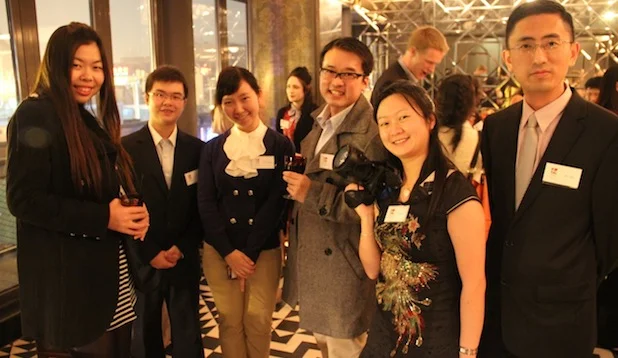
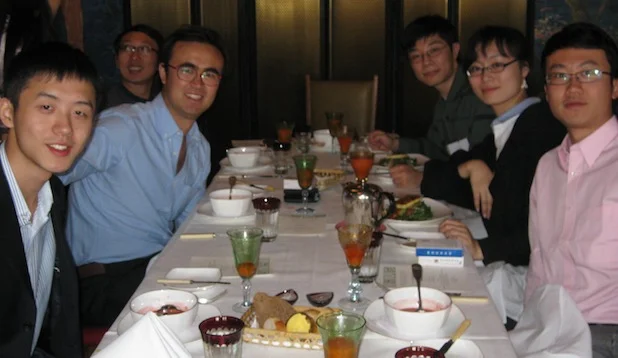
On the 13th of July, 2012 Australian ACYD delegate Wesa Chau (second from the right) was featured in an article by The Age's Peter Cai: 'On the campaign trail: the Asian-Australian story'. Wesa is campaigning as the Labor candidate for the federal seat of Higgins in the 2013 federal election. She can be found on Twitter at @wesachau. Peter Cai is also an ACYD Alumni. He was a 2010 Australian ACYD delegate and a speaker at the 2011 ACYD.
往届中澳青年对话的代表们,如今人在何方?...周康

ACYD Alumni...where are they now? Andrea Myles

The 2011 Australia-China Youth Dialogue (ACYD) foretold a new chapter in my professional development. Being selected as an ACYD delegate was the first time I’d ever seen myself as a leader within the Australia China space. It was also the first time I’d encountered people of my own generation collectively acting as leaders and co-creating a new sort of dialogue between our countries. Since the ACYD, I have had the pleasure of working with an amazing team of co-founders and ambassadors on the Engaging China Project, a youth-lead social enterprise which ignites the idea of China in Australian high schools and is the funnel end of the Australia-China Youth Association Group. At present I’m acting General Manager of the Australia China Business Council, the premier business organisation dedicated to promoting business and trade between Australia and the People’s Republic of China. It’s very exciting to keenly observe the full spectrum of the AusChina trade and investment relationship across all sectors and craft big projects which both lead and support.
For any media enquiries, please contact Fiona Lawrie at fiona.lawrie@acyd.org.au.
ACYD Alumni, Tom Williams, Selected as a Member of 'New Colombo Plan' Steering Group

Tom Williams, a 2011 ACYD Delegate, ACYA National President (Australia), has been selected as a member of the Liberal Party's 'New Colombo Plan' steering group. The aim of the New Colombo Plan is to 'send so many Australians to study at Asian universities and become interns working in Asia, that it will become a rite of passage for future generations.' For more information on the New Colombo Plan and the other steering group members, please see this article (please note: it requires a subscription)
ACYD Alumni interviewed in Australian Education International documentary

Henry Makeham, founder of the ACYD, and Fiona Lawrie, a 2012 ACYD delegate, were interviewed in Australian Education International's documentary titled Australia-China: Four decades of collaboration and research.